

When marketing reports CPL is down, but sales indicates that the leads are unusable, this could be a clear sign that your conversion stream is contaminated.
Unlike signal loss causing blind spots, dirty signals are worse because they steer budget in the wrong direction. Once bad inputs enter optimization, the failure compounds across targeting, pipeline, and forecasting.
At times, brands may react to poor-quality leads by cutting paid media spend or switching channels. Maria Escobedo, Data Analyst at Found Search Marketing, shares that the better move is to treat lead integrity like an input control: clean what feeds the algorithm before you change strategy.
“Dirty signals create false confidence. The dashboards show progress, but the model is learning from the wrong buyers.”

Dirty Signals Are Worse Than Signal Loss
Dirty signals are conversion events that tell the platform “this is a good buyer” when it is not.
Signal loss hides performance because conversions are missing. Dirty signals misdirect performance because conversions are wrong. Both drive bad allocation decisions, but dirty signals create false confidence because dashboards still populate.
You are not just wasting spend. You are training the platform to chase the wrong customer.
What Counts as a Dirty Signal
- Bots and fake form fills (fraud) are the most obvious culprits.
- However, low-intent leads from real humans who are simply the wrong fit are just as damaging.
- Poor-quality lead lists or CRM uploads used to seed targeting and lookalikes can also act as dirty signals.
- Incentivized traffic that behaves like converters but never becomes pipeline is another major source.
Not all bad leads are fraud, but the impact is the same at the end of the day: the model learns the wrong pattern.
Where the Loop Gets Poisoned
In our experience, contamination enters in predictable places, especially when you scale fast.
- Audience expansion and network partners. Scale levers can introduce less transparent inventory and low-intent traffic.
Symptom: Lead volume rises while sales acceptance and opportunity rates fall. - Low-friction lead capture paths. Short forms and broad offers increase conversions, but also increase low-intent submissions.
Symptom: Speed-to-lead improves while pipeline quality declines. - Conversion definitions that reward the wrong moment. If a raw lead is treated as success, the platform optimizes to raw leads.
Symptom: CPL improves while qualified pipeline stays flat. - Bad CRM inputs used for targeting and lookalikes. Garbage lists create garbage lookalikes.
Symptom: ICP drifts and you buy cheaper but less relevant audiences. - Placement and source blind spots. Quality problems often concentrate in a small set of placements or sources not visible in exec rollups.
Symptom: Unexplained spikes in leads from a narrow slice of inventory.
How Dirty Signals Wreck Optimization and Lookalikes
Platforms optimize to the conversions you feed them. If those conversions are junk, the model scales junk.
- First, junk gets recorded as a conversion, and the platform treats it as success.
- Second, automated bidding finds more of what looks like that converter—often the easiest-to-produce behavior.
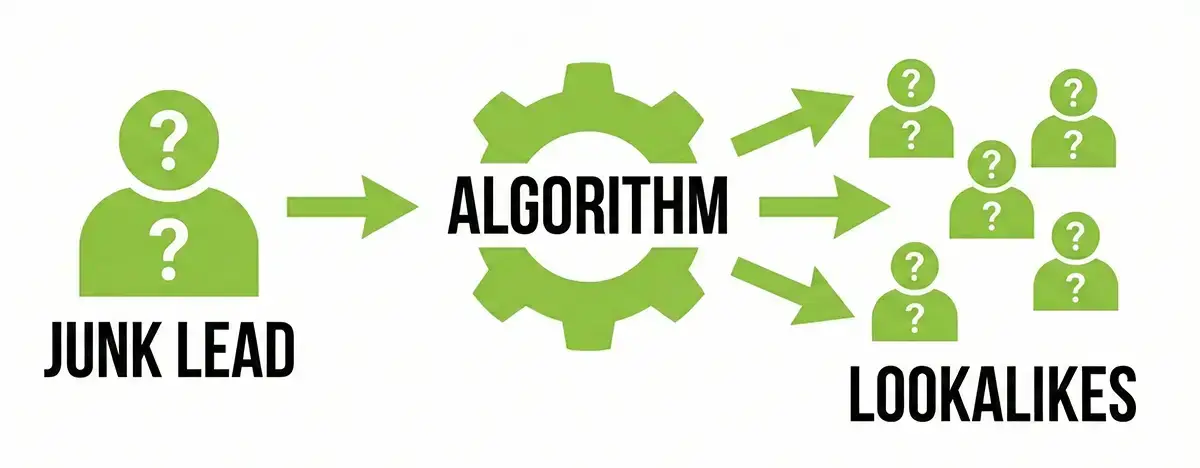
- Third, lookalikes and audience expansion amplify the pattern, widening reach to similar low-quality users.
- Fourth, your real ICP gets crowded out by cheaper-to-acquire junk behavior.
You do not just get bad leads. You get a worse model.
Our latest white paper includes a step-by-step guide for building a closed-loop data system that feeds real revenue intelligence (not noisy browser signals) back into your ad platforms. Download it here.
The Junk Lead Economy: Quantifying Wasted Spend
You pay twice. Media waste is visible, operational waste is hidden. Your organization absorbs costs in SDR time, routing, enrichment tools, RevOps cleanup, CRM hygiene, AE time, and reporting disputes.
THE JUNK LEAD COST MODEL:
Total Cost = (Junk Leads x Cost per Lead) + (Junk Leads x Cost to Process per Lead)
The Dashboard Problem
CPL and platform conversions can look stable (or better) while downstream quality collapses.
Lead volume is a vanity metric if “valid lead” is not enforced and audited.
Finance distrust is rational: if the scoreboard can be gamed, it will be.
How to Spot Contamination Early
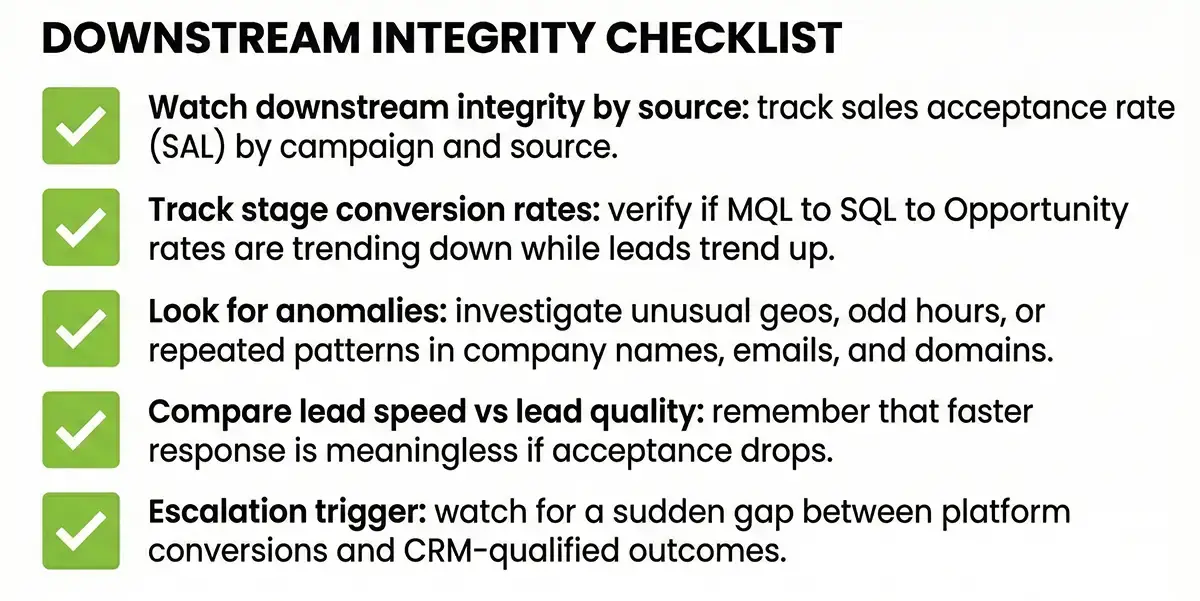
What Governance Looks Like
- Define “valid lead” in writing: a lead that sales accepts as a plausible path to revenue.
- Align conversion events to value: do not optimize solely on raw leads when they are contaminated. Consider mid-funnel conversions (SQL, Opportunity) when volume supports it.
- Get vendor accountability: require transparency for partner networks and make quality a contractual KPI, not just volume.
- Make lead integrity cross-functional: marketing defines intent signals, sales validates, and finance cares because it changes capital allocation.
Clean Signal Beats More Signal
More tracking and more events do not fix dirty inputs—clean, compliant signal does.
Maria shares that this is not about skirting consent. “It is about using and activating the data you can capture in a way you can trust. Teams that enforce signal quality make better allocation decisions and compound advantage.”
FAQ’s
What are dirty signals in paid media?
Dirty signals are contaminated conversion events—like bots or junk leads—that enter your ad platforms. They create a feedback loop that misdirects optimization algorithms toward low-quality traffic.
How does bot traffic affect ad optimization?
Bots create counterfeit conversions, tricking the platform into thinking a campaign is successful. The algorithm then seeks more traffic with similar characteristics, amplifying waste.
Why do lookalike audiences get worse over time?
Lookalikes mirror the seed data provided to them. If you feed the system junk leads or bad CRM data, the lookalike audience will be built to resemble those low-quality profiles.
How can we quantify the cost of junk leads?
You must calculate the “double cost.” Add the media spend wasted on acquiring the bad lead to the operational cost (SDR hours, data enrichment fees, and CRM maintenance) of processing it.
Not sure where to start? Take Found’s Signal Quality Assessment today to evaluate your organization’s data infrastructure.