

The Heat-Wave Demand Spike
Most HVAC contractors treat summer as the season they react to. The phone rings, the crew scrambles, the schedule fills. By the first 90-degree week in the Midwest, the demand is already there and so is every competitor bidding for it. It becomes a paid media scramble in a time-sensitive environment.
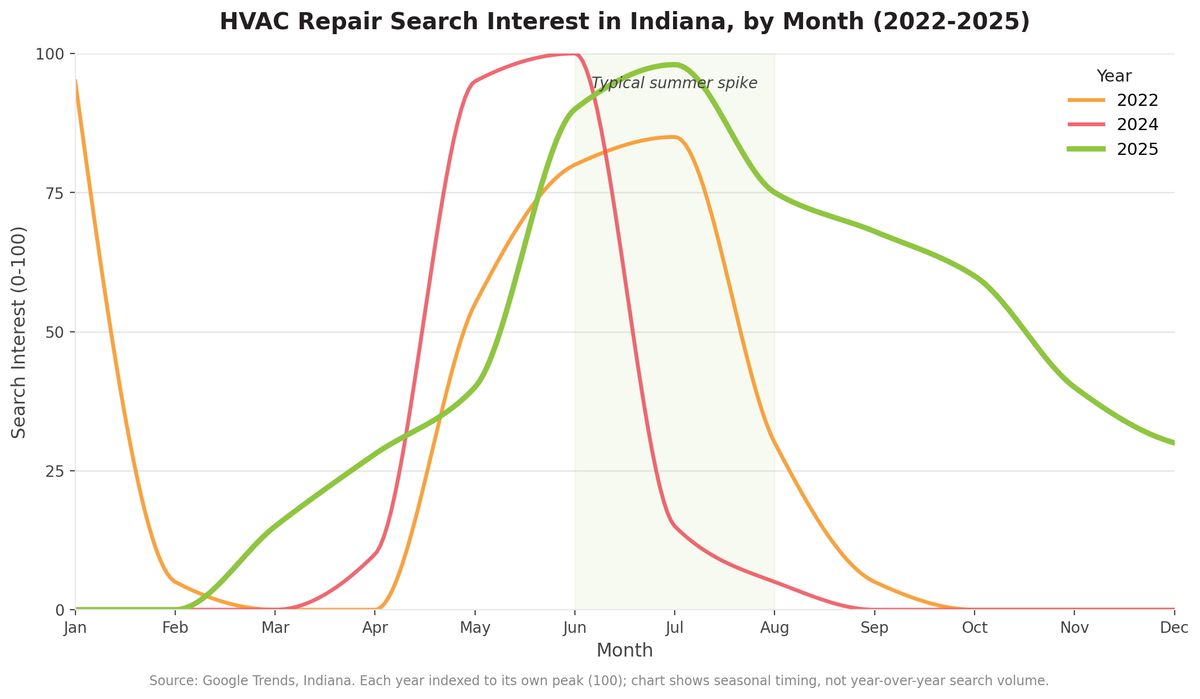
Here is what gets missed: the demand curve is predictable months in advance, and so is the paid media search competition that comes with it.
Searches for "AC repair" climb 266% from February to July nationally. HVAC has the sharpest seasonal swing of any home-services trade, with peak-to-valley search variance regularly running 250% to 600%. Plumbing and electrical have their spikes, but nothing matches the cooling-season surge.
Why this hits the Midwest harder for HVAC Spikes
AC search demand tracks a local temperature threshold: interest climbs sharply once daytime highs cross roughly 85°F. In year-round-warm markets, that threshold gets crossed gradually. In Indiana, Ohio, Illinois, Michigan, and Kentucky, it usually gets crossed all at once. The Midwest region goes from mild spring to full heat in weeks, compressing the spike into a shorter, steeper window.
That compression is a problem and an opportunity. Contractors who treat July as the starting line pay peak cost per click for every lead, and maximize their paid media budget quickly. The ones already visible when the heat lands capture the same demand for a fraction of the cost.
Found's Approach: Budget Paid Media Investment by the Demand Curve, Not the Calendar
The strategy is not "spend more in summer." The strategy is letting demand set the pace.
Many HVAC accounts cap their paid media investment by the month, and perhaps based on their region's particular climate patterns: a flat number in May, another in July. That ignores the curve entirely. Stop budget-capping by month, set ROAS targets, and let media spend fluctuate as demand comes in and jobs get booked.
When the heat lands and the phone rings, the campaign scales with it instead of hitting an artificial ceiling at the moment leads are most valuable.
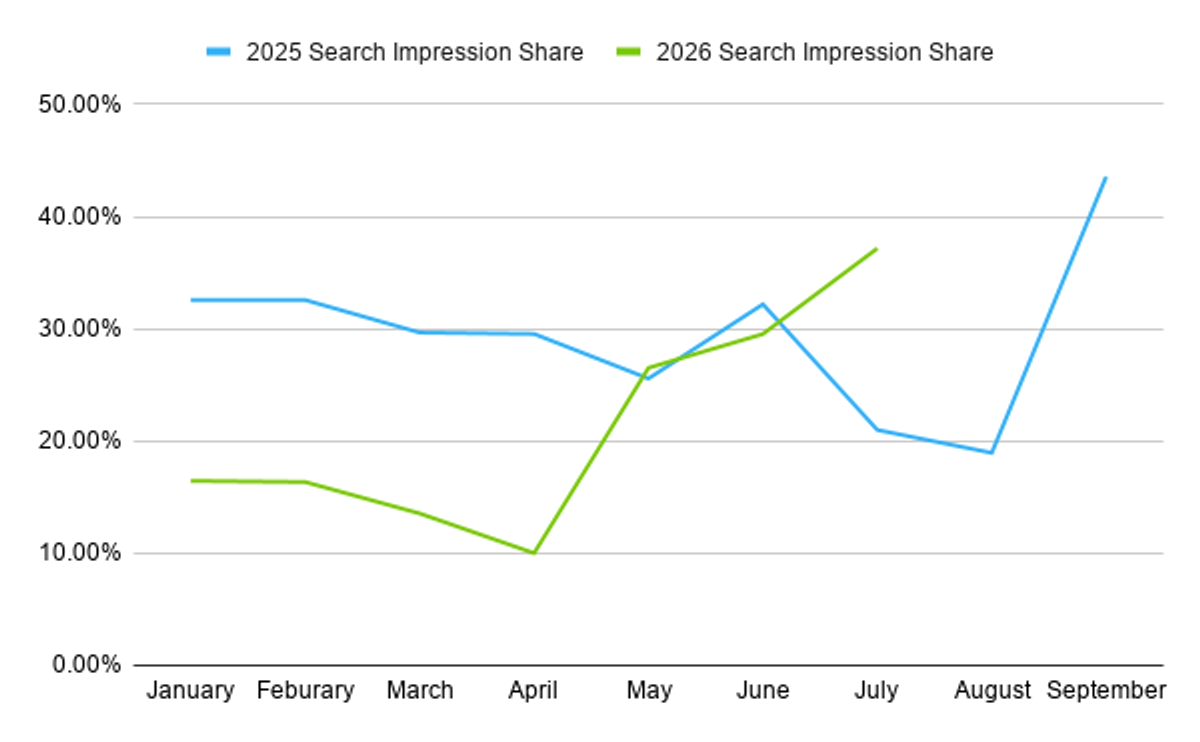
Especially in Indiana, a spike in July of last year may not be the same spike in July of this year. When our team compared 2025 to 2026, search impression share spikes in completely different months in Indiana. The spike in 2025 came in September at 43%, whereas the latest Midwest heat wave spike in 2026 occurred in July at 37%.
Model off of Actual Customers
"When we're working with our HVAC partners, we don't guess at what a lead is worth. We model real customer value and feed it back, so the account is always learning and adjusting in real time based on actual customers. This allows their paid media campaigns to scale effectively and reserve budget for high-intent customers at the right time."

If the demand is there, and you have staff to respond, you need to capture it at that moment. Data signals provide that information, and make this system work. You just need to send those signals back. Every customer has a different value depending on where they live, what service they clicked, and what season it is.
"When our paid media team works together with our HVAC clients to pass real revenue values back to the ad platforms (and not just 'a lead came in'), it allows the modern bidding algorithms to learn which clicks are worth chasing, and which are not, and then your paid media budget adjusts as high-demand business rolls in."

Just remember:
- Optimize for cheap leads = Cap the media budget and pass back thin data
- Optimize for booked jobs = Pass back revenue and target ROAS
Simply put: if people are booking, you bid more and spend more media dollars. If they aren't, you bid lower, waste less and conserve your media budget for when demand spikes.
Capturing the high-intent leads when they spike
Execution turns a peak-season search into a booked call, and the contractors who win them have three things dialed in before the heat arrives:
- Google Business Profile. A homeowner searching "AC repair near me" sees the map pack first, often before any website. Keep the profile optimized year-round: current photos of vans and technicians, accurate service areas, and a steady flow of recent reviews.
- Service-specific landing pages. Generic "HVAC services" pages bleed traffic. Break the site into distinct pages for distinct intent: 24/7 emergency AC repair, compressor replacement, annual maintenance plans. Each page matches a specific search, lifting both organic ranking and paid media conversion.
- Paid search built for conversion. In July 2026, when the Midwest and much of the country was having a massive heat wave, we saw emergency HVAC CPCs peak at $40, but other areas of the country have reported $50 to $100-plus per click at peak. At those rates, sending traffic to a generic homepage burns your paid media budget and adds an extra step for your customers. Point paid ads to hyper-localized landing pages so every expensive click has its best shot at becoming a call.
The Bottom Line
Your busiest month is not a surprise. It is the most forecastable moment of the year. The question is whether your paid media and data infrastructure are built to anticipate it or react to it.
The contractors who win the summer are the ones who were prepping for it in the first half of the year.
Looking to elevate your HVAC or home services marketing with advanced data engineering and paid media expertise? Let's talk.